
Original: $395.00
-70%$395.00
$118.50The Story
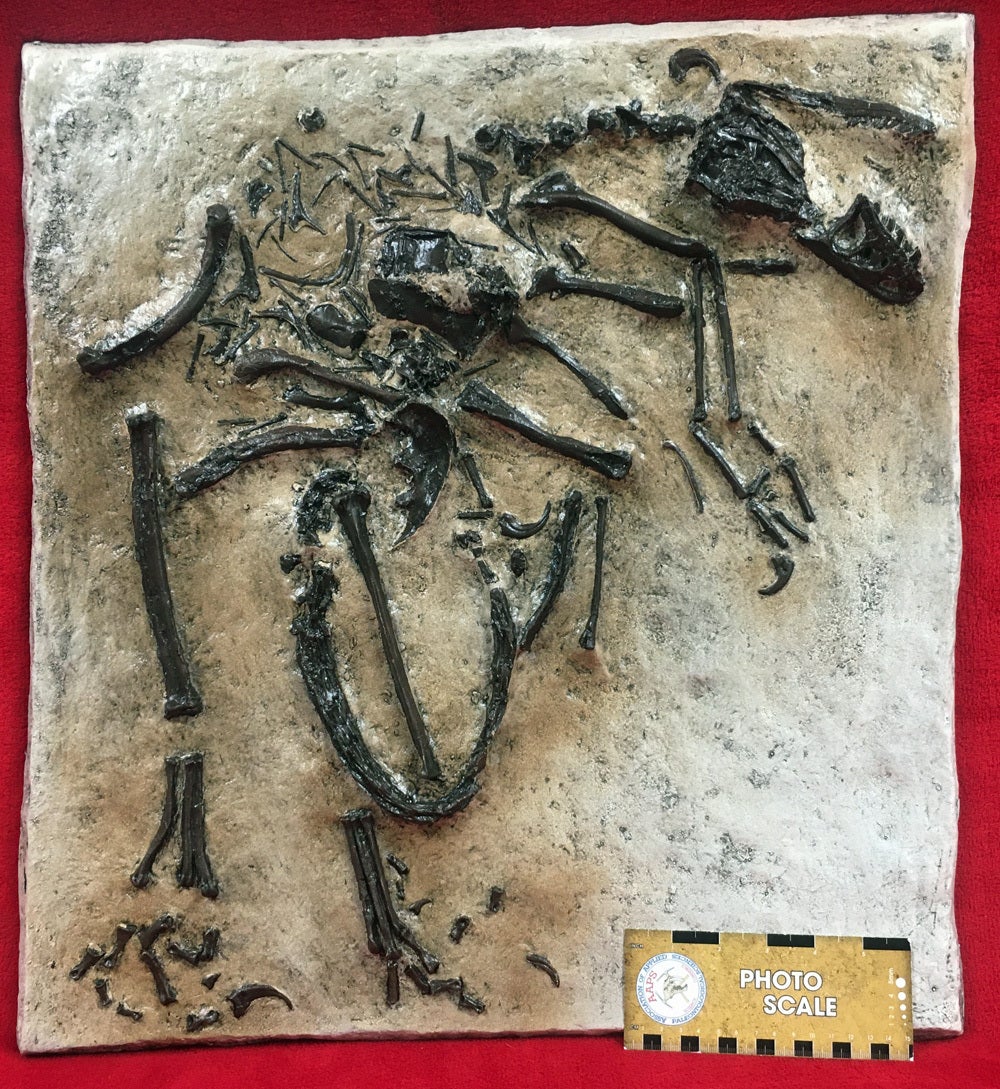
Bambiraptor feinbergi, in situ skeleton cast replica
Bambiraptor feinbergi
insitu skeleton
Two Medicine Formation
Cretaceous Age
Montana, USA
21.5x20 inches
resin
The idea that birds are living dinosaurs has been accepted by most paleontologists for some time. But the discovery of Bambiraptor has led to some intriguing new ideas about the strong links between birds and dinosaurs.
Feathered Family
Around 90 percent of the specimen’s bones were recovered, making it one of the most complete ever found in North America. With so much of the skeleton to study, researchers were able to learn some surprising details about this fossil. Bambiraptor was probably covered in feathers, and its skeleton was almost identical to that of a modern bird. Based on analysis of the skull, scientists think that this species had a brain nearly as large as the brains of some modern birds.
Bambiraptor belongs to the group of dinosaurs called dromaeosaurs, which are very closely related to modern birds. Dromaeosaurs had feathers and other features like hollow bones that are used in flight. But these dinosaurs could not fly because their arms were too short to function as wings. Features like feathers and hollow bones evolved first in dinosaurs that lived on the ground or climbed trees. These traits were only later used for flight. Scientists now think that modern birds are very closely related to the family of dinosaurs known as dromaeosaurs, which include Bambiraptor.
Fast Facts: Bambiraptor
Species: Bambiraptor feinbergi Pronunciation: BAM-be-rap-tor fine-BERG-eye
Length: 0.7 meters (30 inches)
Height: 0.3 meters (12 inches)
Weight: 2 kilograms (4.4 pounds)
Food: small mammals and reptiles
Cretaceous
Fun fact: The large claw on Bambiraptor’s second toe was probably used for killing prey, suggesting the animal was a fierce hunter

Details & Craftsmanship
Every detail has been carefully considered to bring you the perfect product.

Details & Craftsmanship
Every detail has been carefully considered to bring you the perfect product.

Details & Craftsmanship
Every detail has been carefully considered to bring you the perfect product.

Details & Craftsmanship
Every detail has been carefully considered to bring you the perfect product.
Details & Craftsmanship
Every detail has been carefully considered to bring you the perfect product.
Description
Bambiraptor feinbergi, in situ skeleton cast replica
Bambiraptor feinbergi
insitu skeleton
Two Medicine Formation
Cretaceous Age
Montana, USA
21.5x20 inches
resin
The idea that birds are living dinosaurs has been accepted by most paleontologists for some time. But the discovery of Bambiraptor has led to some intriguing new ideas about the strong links between birds and dinosaurs.
Feathered Family
Around 90 percent of the specimen’s bones were recovered, making it one of the most complete ever found in North America. With so much of the skeleton to study, researchers were able to learn some surprising details about this fossil. Bambiraptor was probably covered in feathers, and its skeleton was almost identical to that of a modern bird. Based on analysis of the skull, scientists think that this species had a brain nearly as large as the brains of some modern birds.
Bambiraptor belongs to the group of dinosaurs called dromaeosaurs, which are very closely related to modern birds. Dromaeosaurs had feathers and other features like hollow bones that are used in flight. But these dinosaurs could not fly because their arms were too short to function as wings. Features like feathers and hollow bones evolved first in dinosaurs that lived on the ground or climbed trees. These traits were only later used for flight. Scientists now think that modern birds are very closely related to the family of dinosaurs known as dromaeosaurs, which include Bambiraptor.
Fast Facts: Bambiraptor
Species: Bambiraptor feinbergi Pronunciation: BAM-be-rap-tor fine-BERG-eye
Length: 0.7 meters (30 inches)
Height: 0.3 meters (12 inches)
Weight: 2 kilograms (4.4 pounds)
Food: small mammals and reptiles
Cretaceous
Fun fact: The large claw on Bambiraptor’s second toe was probably used for killing prey, suggesting the animal was a fierce hunter